
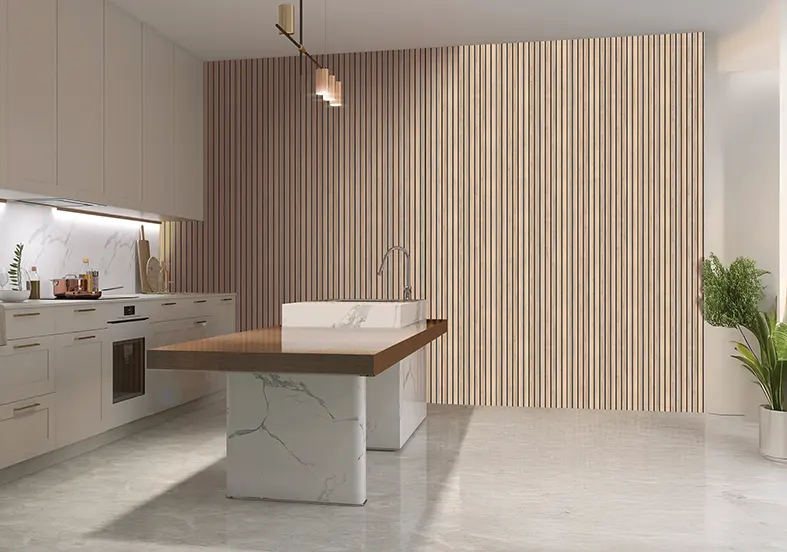
When people think of waterproof wall panels, they usually picture a shower or an en-suite. But some of the most popular questions we get asked are about kitchens — can panels handle splashbacks, feature walls, and utility rooms? The short answer is yes, and in many cases they're a better choice than tiles. Here's why.
Splashbacks that shrug off grease and steam
The area behind a hob or sink takes a daily battering from steam, oil splashes, and general kitchen chaos. Grouted tile splashbacks look fantastic on day one, but grout lines are porous, and over time they trap grease and discolour — no amount of scrubbing fully brings them back. A single waterproof panel has no grout at all, so there's nowhere for grease or bacteria to take hold. A quick wipe-down after cooking is all it needs.
Feature walls without the fuss
A bold panel finish behind an island or along a run of cabinetry makes a striking feature wall, and because panels come as large, seamless sheets, you get a completely uninterrupted surface — no tile pattern, no grout lines breaking up the design. For anyone going for a fluted, stone-effect, or dark matte look in their kitchen, panelling gives a cleaner, more contemporary finish than tiling ever could.
Utility rooms and boot rooms
Utility rooms take even more punishment than kitchens — wet washing, muddy boots, dog-washing stations — so a genuinely waterproof wall covering matters more here than almost anywhere else in the house. Panelling the walls of a utility room protects the plaster underneath from splashes and condensation, and it's far quicker to install and keep clean than tiling, which matters in a space that's rarely anyone's design priority.
What to check before you specify panels for a kitchen
- Heat resistance near hobs — leave the manufacturer's recommended clearance from any heat source, the same as you would with tiles.
- Panel thickness and rigidity — kitchens see more day-to-day knocks than bathrooms, so a slightly heavier-duty panel is worth choosing for splashback areas.
- Cut-outs for sockets and taps — panels can be cut cleanly on site for sockets, extractor controls, and taps, but it's worth planning these positions before installation to avoid unnecessary joins.
The bottom line
Waterproof wall panels aren't just a bathroom product. Used well, they solve exactly the same problems in a kitchen or utility room — moisture, grease, and grime — while giving a cleaner, more modern finish than tiling, in a fraction of the installation time. If you're planning a kitchen splashback or utility room refit, it's well worth considering panels alongside (or instead of) tiles.